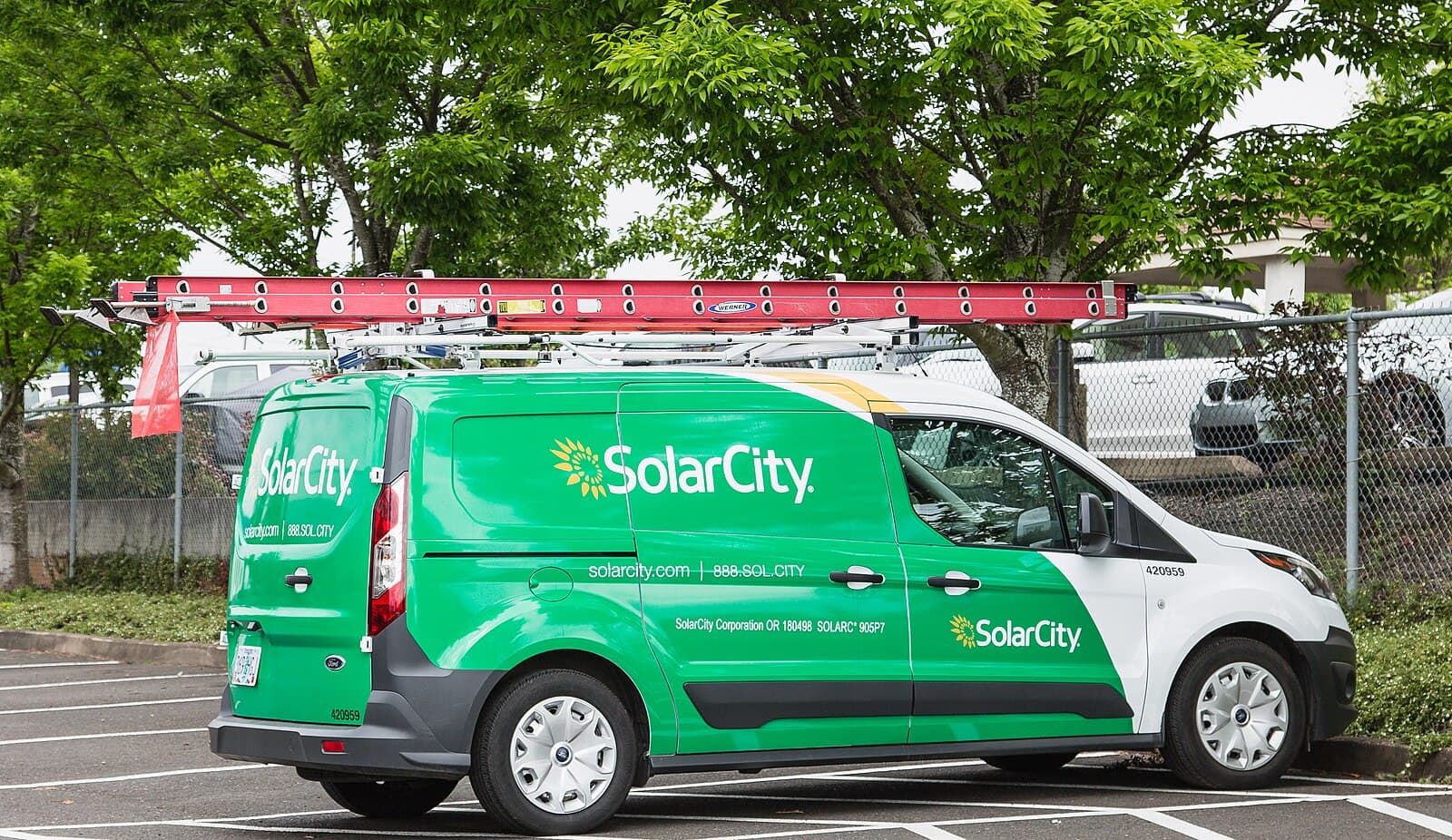
Photo by Tony Webster (CC BY 2.0)
SolarCity
Musk-funded residential solar installer. Acquired by Tesla in 2016 in a $2.6B deal that triggered a multi-year shareholder lawsuit.
Photos
SolarCity was Musk's attempt to close the other side of a sustainable energy equation: if Tesla electrifies transport and the grid stores clean energy, someone has to generate it at the consumer level. He funded his cousins Lyndon and Peter Rive to build what became America's largest residential solar installer. The 2016 acquisition by Tesla for $2.6 billion was immediately controversial — a related-party deal that took six years to fully resolve in court. Today the Solar Roof and Megapack represent SolarCity's legacy, integrated inside Tesla Energy.
Founding Story
SolarCity traces its origin to Burning Man 2004, where Musk floated the concept to his cousins Lyndon and Peter Rive: a company that would handle the full residential solar stack — design, permitting, equipment, installation, financing — as a single turnkey service. The Rive brothers incorporated on July 4, 2006. Musk provided the initial capital and became chairman.
The company's model was built on leases and power-purchase agreements: homeowners paid nothing upfront and instead signed long-term contracts to buy the electricity generated by panels on their own roofs. This removed the largest barrier to solar adoption and turned SolarCity into the country's largest residential solar installer by 2014.
By 2016, SolarCity was in serious financial difficulty. In August 2016 Musk proposed a Tesla acquisition at ~$2.6 billion all-stock. Critics immediately noted the conflict: Musk was Tesla's CEO, SolarCity's chairman, and its largest individual shareholder simultaneously. A Delaware court ruled in his favor in April 2022. SolarCity's legacy lives in Tesla Energy: the Solar Roof, Powerwall, and Megapack lines.
- Nov 21, 2016Tesla acquires SolarCity for $2.6BTesla closes the all-stock acquisition of SolarCity, folding it into what becomes Tesla Energy. Critics call it a bailout of a company where Musk's cousins are executives and Musk …
Overview
SolarCity was founded in 2006 by Lyndon Rive and Peter Rive — Elon's cousins — based on an idea floated by Elon at Burning Man 2004. Elon was the largest shareholder and chairman of the board from inception. SolarCity grew to become the largest US residential solar installer by 2014. In 2016, Tesla acquired SolarCity for ~$2.6B in an all-stock deal, integrated as Tesla Energy. Tesla shareholders sued, alleging Musk had bailed out the failing company at unfavorable terms; a Delaware Chancery Court found in Musk's favor in April 2022.
Elon's Role
Co-founders
Key Milestones
- Jul 4, 2006founding
SolarCity founded
Rive brothers incorporate, with Musk as chairman.
- Dec 13, 2012ipo
SolarCity IPO
$8/share; raised $92M. Stock would later quadruple in 2014.
- Nov 21, 2016acquisition
Tesla acquires for $2.6B (all stock)
Folded into Tesla Energy. Shareholder lawsuit follows.
- Apr 27, 2022lawsuit
Delaware court rules for Musk
Chancellor Slights finds Musk did not breach fiduciary duty.
Predictions
Solar Roof will be cheaper than a regular roof when you account for the cost of electricity.
Solar Roof production ramped slowly. By 2021-2022 Tesla faced criticism for high prices and installation delays. Long-term economics depend heavily on electricity prices.
Within 10 years, solar plus stationary storage will be cheaper than any fossil fuel energy in all markets.
Solar LCOE has become the cheapest electricity source in most markets. Battery storage costs have also dropped dramatically, though full parity on all grids remains in progress.
Tesla Megapack will be deployed at gigawatt-hour scale globally within 5 years, stabilizing grids worldwide.
Tesla Energy revenue grew significantly and multi-GWh Megapack projects have been deployed in Australia, California, and elsewhere. Global scale is growing but 'worldwide grid stabilization' is still limited.
Controversies & Disputes
SolarCity acquisition shareholder lawsuit
lawsuit2022Tesla shareholders sued Musk and the Tesla board in Delaware Chancery Court, alleging that the $2.6B acquisition of SolarCity in 2016 was a bailout of a failing Musk-family company (Musk, his brother Kimbal, and his cousins the Rive brothers all had stakes) at Tesla shareholder expense. The plaintiffs argued Tesla overpaid for a company facing existential cash problems.