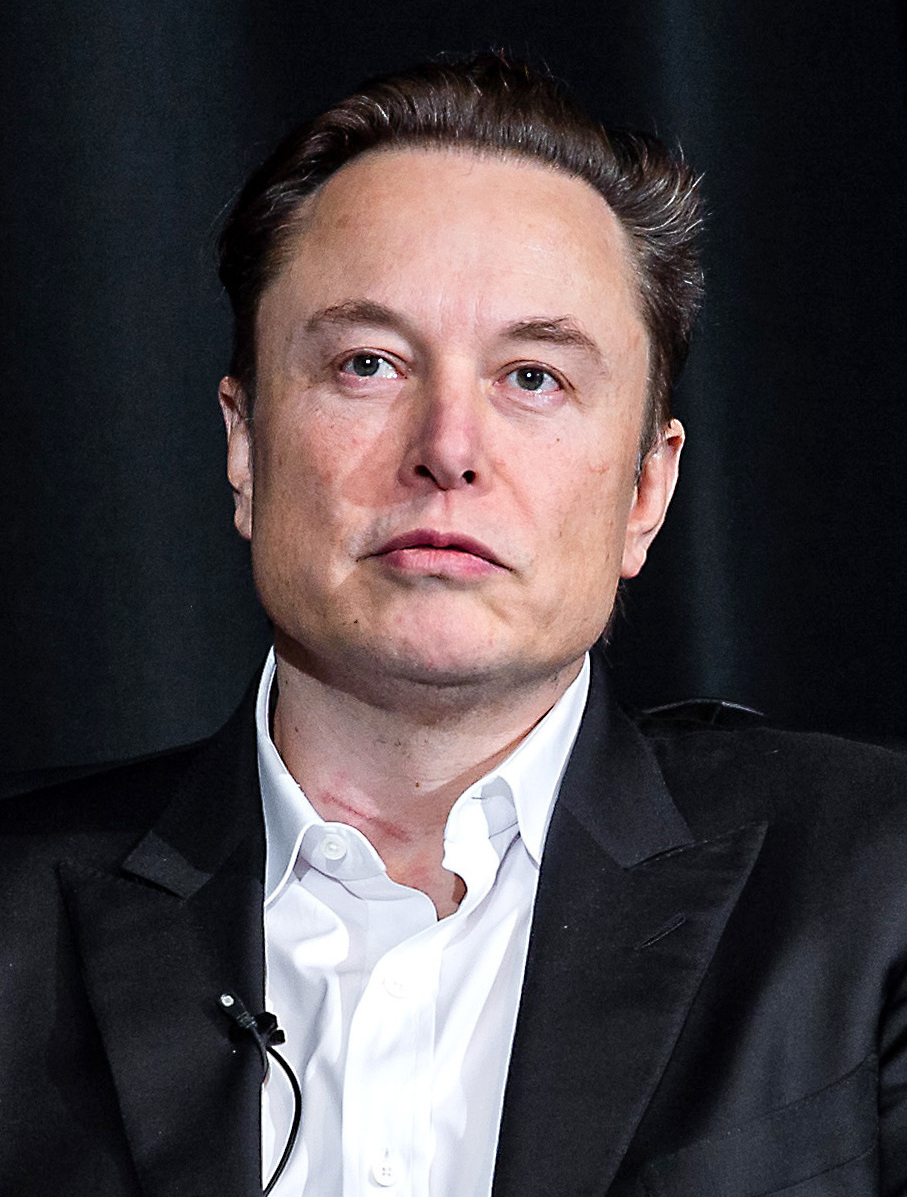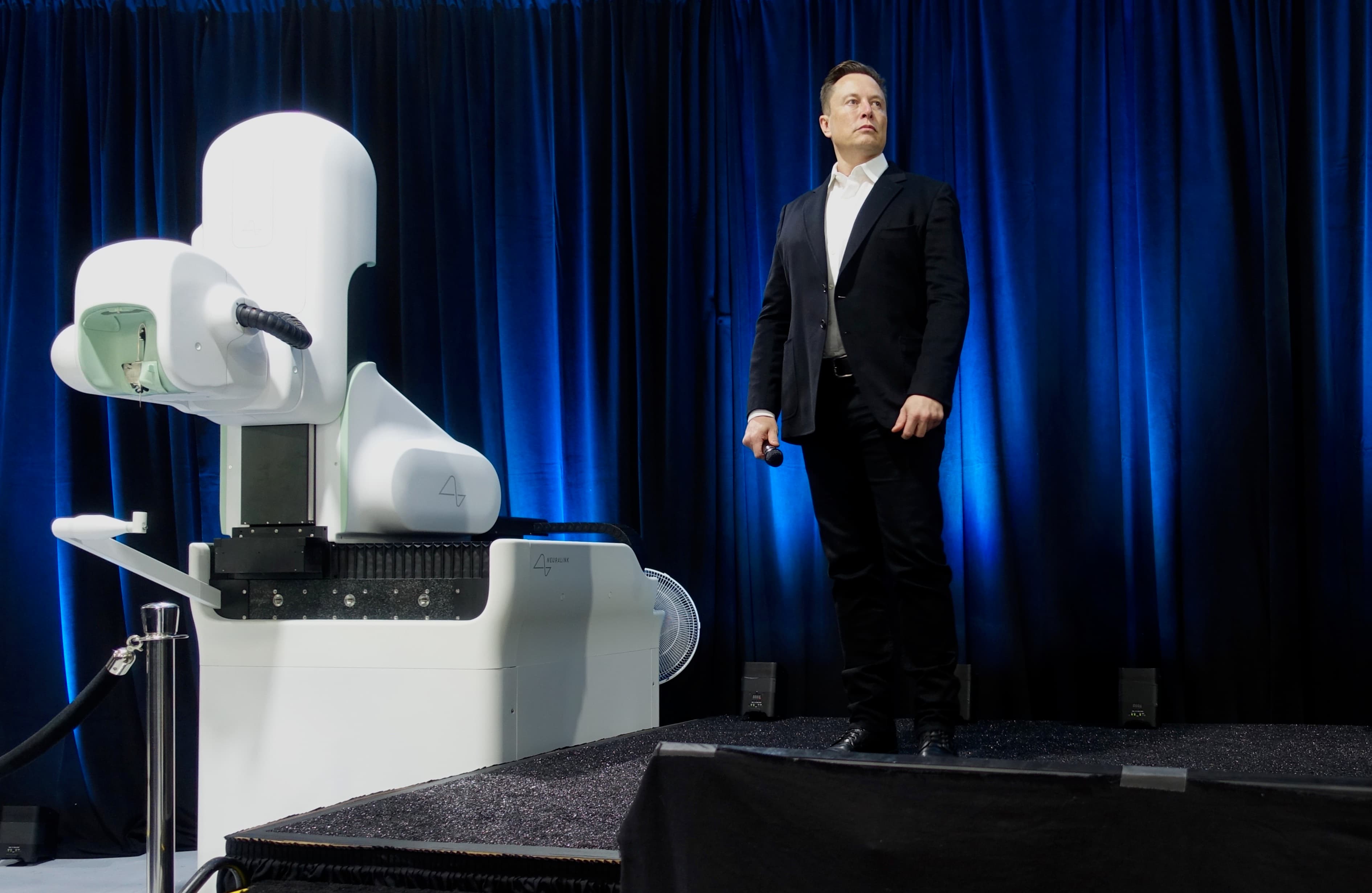
Photo by Steve Jurvetson (CC BY 2.0)
Neuralink
Implantable brain-computer interfaces. From paralysis treatment to a long-term Musk thesis on AI symbiosis.
Photos
Neuralink starts from a very long-run Musk thesis: that artificial superintelligence will arrive within decades, and that the safest path for humanity is not to oppose it but to merge with it. The immediate mission — restoring motor function to the paralyzed — is simultaneously a humanitarian project and a proof-of-concept for the harder problem of high-bandwidth brain-computer symbiosis. A coin-sized chip, threads thinner than a human hair, and a robot surgeon are the first practical steps toward an architecture Musk believes determines the long-run fate of consciousness.
Founding Story
Neuralink was incorporated in July 2016 — quietly, with no press release. The founding team, assembled from neural engineering and neuroscience (Max Hodak, DJ Seo, Vanessa Tolosa, Ben Rapoport, among others), was kept secret for nearly two years. The company's existence became public via a WaitButWhy essay in March 2017, in which Musk laid out his foundational argument: AI will surpass human intelligence, the only viable response is to increase human bandwidth, and the only way to do that is with a direct neural interface.
The near-term application is medical: restoring motor and sensory function to people with spinal cord injuries and neurological conditions. The long-term application — what Musk calls 'layer three' — is a high-bandwidth connection between human cognition and AI systems.
The PRIME Study received FDA clearance in May 2023. The first human patient, Noland Arbaugh — paralyzed below the shoulder from a diving accident — received the Link implant on January 29, 2024. Within weeks he was using thought alone to move a cursor, play chess, and browse the web. A second patient followed in August 2024.
- Jul 2016Co-founds NeuralinkCo-founds Neuralink with Max Hodak and other neuroscientists to develop implantable brain-computer interface technology for medical and eventually augmentation applications.
- Apr 8, 2021Pager the monkey plays Pong with his mindNeuralink releases video of Pager, a macaque monkey with bilateral brain implants, playing Pong and a MindPong game using only neural signals. Draws significant media attention.
- May 25, 2023Neuralink receives FDA clearance for human trialsThe FDA approves Neuralink's Investigational Device Exemption, allowing the PRIME Study (Precise Robotically Implanted Brain-Computer Interface) to proceed with human participants.
- Jan 29, 2024First human Neuralink implant — Noland ArbaughNoland Arbaugh, paralyzed from the shoulders down after a diving accident, receives the first human Neuralink implant. Within weeks he demonstrates controlling a computer cursor an…
- Aug 20, 2024Second human Neuralink implantA second participant receives a Neuralink implant. Neuralink reports improved electrode performance over the first implant, addressing wire retraction issues seen in the first pati…
Overview
Founded in 2016 by Elon Musk and a team including Max Hodak, DJ Seo, Tim Hanson, Vanessa Tolosa, Ben Rapoport, and Paul Merolla. Public reveal in 2019. The company developed a coin-sized implant ("Link") with thread-thin electrodes inserted by a custom surgical robot. Animal trials began ~2017; FDA approval for human trials came May 2023. First human implant in Noland Arbaugh in January 2024, who used the device to play chess and online games via thought.
Elon's Role
Co-founders
Key Milestones
- Jul 2016founding
Neuralink founded
Incorporated as a medical research company.
- Mar 27, 2017other
Public unveiling
WaitButWhy long-form essay reveals Musk's involvement and brain-machine-interface vision.
- Jul 16, 2019product
First public demo
San Francisco event introduces 'sewing-machine' surgical robot and N1 chip.
- Aug 28, 2020product
Three pigs livestream
Live demo of implanted pigs ('Gertrude') showing real-time neural signals.
- Apr 9, 2021product
Pager the monkey plays Pong
9-year-old macaque demonstrates cursor control via neural signals only.
- May 25, 2023product
FDA clearance for human trials
PRIME Study (Precise Robotically Implanted Brain-Computer Interface) approved.
- Jan 29, 2024product
First human implant
Noland Arbaugh receives Link implant; later demonstrates playing chess via thought.
- Aug 2, 2024product
Second human patient (Alex)
Patient with C4–C5 spinal cord injury implanted.
Notable Tweets
Predictions
We hope to have the first human Neuralink implant within a year.
FDA approval for human trials came in May 2023. First implant occurred January 2024.
We hope to start human trials within approximately a year, pending FDA approval.
FDA initially rejected the application. Approval came in May 2023, first implant January 2024.
Neuralink will have its first human implant within 6 months.
First human implant occurred in January 2024, roughly 2 years later.
Famous Quotes
“We are already a cyborg to a degree that we don't appreciate. You have a digital version of yourself online. If we can create a high-bandwidth interface to the brain, we can actually go along for the ride.”
— Joe Rogan Experience #1169, Sep 2018
“Your input bandwidth to your phone is very slow. It's like a slow serial connection. Neuralink wants to create a high bandwidth interface to the digital world such that you can actually be symbiotic with AI instead of left behind.”
— Neuralink launch event 2019, Jul 2019
“The first use will be in people with serious spinal cord injuries or ALS, so that they could use a computer or phone faster than someone who doesn't have a spinal cord injury.”
— Neuralink progress update 2020, Aug 2020